


In today’s digital-first business environment, a corporate audiovisual installation is no longer just about placing screens in meeting rooms or adding speakers to boardrooms. It has evolved into a strategic platform that supports internal communication, collaboration, brand storytelling, and immersive engagement.
At the center of this transformation is LED display technology. Once associated mainly with advertising and entertainment, LED is now redefining what is possible in corporate environments—both functionally and visually.
In this article, we explore a next-generation corporate audiovisual installation and share key lessons learned, with a particular focus on how LED displays are reshaping modern workplaces.
Modern enterprises rely on hybrid workflows, global teams, and data-driven decision-making. A well-designed corporate audiovisual installation supports:
Traditional AV setups often fail to scale with these needs. They lack visual impact, flexibility, and long-term adaptability—areas where LED displays and integrated AV systems excel.
Envoy Air, a wholly owned subsidiary of American Airlines Group, implemented a modern digital signage and display solution at its headquarters in Irving, Texas. Facing challenges with outdated standalone signage and inconsistent internal communication, the company deployed a network of Samsung All-in-One 130-inch digital displays supported by a centralized content management system. This allows dynamic distribution of real-time information such as weather alerts, shift schedules, safety notifications, performance metrics, and company news—strengthening internal communication and reinforcing company culture. (AVNetwork)
Key outcomes from this corporate audiovisual installation included:
This case demonstrates how integrated display networks—beyond simple signage—can function as a strategic communication platform in modern enterprises. (Samsung Business Insights)
While not a corporate headquarters per se, the SESI Digital Gallery on the façade of the FIESP building in São Paulo, Brazil illustrates how large-scale LED installations can serve as powerful audiovisual platforms for institutional branding and public engagement. This LED project, often referred to as Latin America’s largest open-air digital art gallery, underwent a major technological overhaul in 2025. Technicians replaced an existing 26,000 LED dot display with more than 120,000 custom-engineered LEDs, resulting in a fourfold increase in resolution and over ten times the brightness, dramatically elevating the visual impact on millions of pedestrians annually. (AVNetwork)
These characteristics align with the needs of corporate audiovisual installations that seek to deliver high-impact visuals for brand narratives, lobbies, and communication hubs.
In this project, LED technology was not treated as a premium add-on—it was the visual backbone of the entire system.
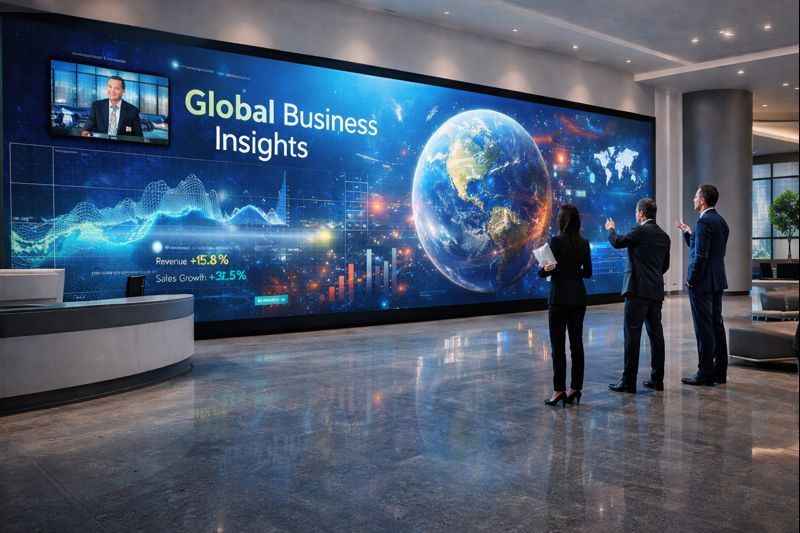
The company’s main entrance featured a large-format LED wall that served multiple functions:
Unlike LCD video walls, the LED solution offered seamless visuals, higher brightness, and complete design freedom. This allowed the installation to become a signature architectural element rather than a standard screen.
Fine-pitch LED displays replaced traditional projection systems in executive meeting rooms. This shift delivered several advantages:
For strategic discussions involving complex data, 3D models, or global video calls, LED provided clarity that directly improved decision-making efficiency.
In innovation labs and creative hubs, curved LED walls and panoramic setups created immersive environments for:
These spaces were not just visually impressive—they actively improved participation and engagement, turning passive meetings into collaborative experiences.
One of the biggest shifts in this corporate audiovisual installation was the move from flat presentation to spatial storytelling.
Instead of asking, “How big should the screen be?”, designers asked:
LED displays made it possible to integrate visuals into walls, columns, and curved surfaces—blurring the line between architecture and media.
Another insight: visual inconsistency undermines professionalism.
With standardized LED solutions across key areas, the company achieved:
This consistency is often impossible with mixed LCD and projection systems. LED made it achievable.
In corporate environments, failure is not an option.
LED displays demonstrated superior reliability compared to traditional solutions:
For IT teams managing large-scale corporate audiovisual installations, this reliability translated into fewer emergency calls and lower maintenance overhead.
Historically, displays were passive output devices. In this installation, LED became an interactive platform:
This shift transformed LED from a “presentation screen” into a “collaboration surface.”
Corporate AV systems often fail because they cannot evolve.
This modularity is essential for any serious corporate audiovisual installation strategy.
Instead of focusing only on specs, companies should ask:
LED-based AV ecosystems scored highest across all four dimensions in this project.
A modern corporate audiovisual installation is no longer an IT accessory—it is a strategic asset.
LED displays, in particular, are driving a fundamental shift:
From screens → to spatial experiences
From presentations → to immersive collaboration
From static content → to dynamic storytelling
Organizations that embrace this transformation will not only communicate better—they will think, collaborate, and innovate differently.

