


A team of Japanese researchers has developed a single-layer LED that emits four stable colors at room temperature. The study was carried out by Osaka University and Ritsumeikan University. The findings were published in Applied Physics Letters.

The new LED produces blue, green, yellow and red light from one light-emitting layer. Conventional full-color displays use separate red, green and blue emitters. The new design follows a different approach. It generates multiple colors from the same emitting region.
The research is still at the laboratory stage. However, it introduces a new concept for future full-color display technologies. It may also provide another direction for MicroLED research.
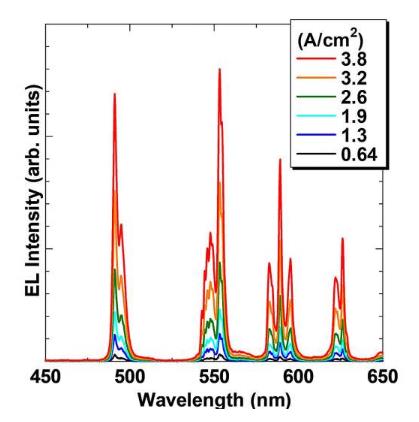
The researchers built the device with aluminum gallium nitride (AlGaN). They doped the material with terbium (Tb) ions. When current was applied, the same light-emitting layer produced four different colors. These included blue, green, yellow and red.
The team also evaluated color stability. They tested the LED under different driving currents. The emission wavelengths remained almost unchanged during the tests. This means the device maintained stable color output under different operating conditions.
The researchers also improved the device’s efficiency. They increased the aluminum content in the semiconductor material. This improved energy transfer to the terbium ions. The external quantum efficiency became up to 10.3 times higher than that of the lowest-aluminum sample.
The team also introduced an aluminum nitride (AlN) buffer layer. This improved crystal quality and reduced defects. The researchers then used color filters to obtain separate red, green and blue light from the same emitting area. These results further demonstrated the potential of the single-layer LED concept.
MicroLED displays usually require separate red, green and blue emitters. Each color is manufactured individually before display integration. This process becomes more difficult as pixel sizes continue to shrink.
The new single-layer LED offers a different idea. It produces multiple colors from one light-emitting layer. This could provide another option for future full-color MicroLED devices. It may also reduce the need for separate RGB emitters if the technology reaches commercial production.
The research is still in its early stages. The authors say further improvements are needed. Device efficiency must be increased. Brightness control also needs to improve. More work is required before the technology can support commercial display applications.
The researchers also see potential beyond display panels. They believe the technology could support future smart glasses, wearable devices and solid-state lighting. These applications will depend on further advances in device performance.
This study introduces a new way to generate multiple colors from a single LED structure. The concept is still under development. However, it shows another possible path for future full-color MicroLED technology.
If the design can be commercialized, it may reduce the reliance on separately manufactured RGB MicroLED emitters. That could simplify pixel integration in some display architectures. However, conventional RGB MicroLED technology remains the industry’s mainstream solution. Large-scale manufacturing will require further improvements in efficiency, color control and production yield.

