


According to Korean media reports released on May 5, Samsung Electronics is carrying out a phased adjustment of its Micro LED TV manufacturing strategy. Rather than aggressively expanding ultra-premium Micro LED televisions, the company now appears to be recalibrating its roadmap around profitability, manufacturing efficiency, and broader market scalability.
The move reflects a growing industry reality: while Micro LED remains one of the most advanced display technologies available today, its commercialization still faces significant obstacles. Extremely complex transfer processes, low mass-production efficiency, and exceptionally high manufacturing costs continue to limit large-scale adoption in the consumer TV market.
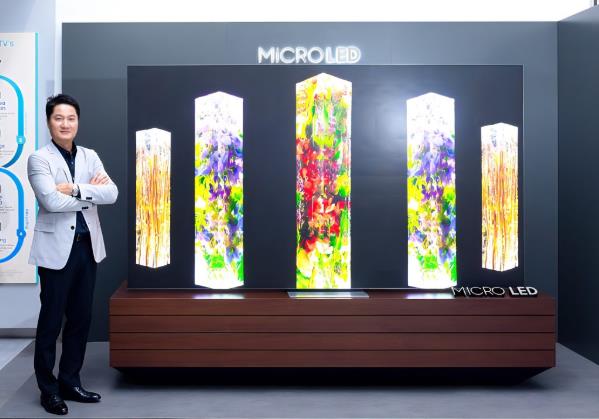
For years, Samsung has positioned Micro LED TVs as the pinnacle of next-generation display innovation. Products such as “The Wall” demonstrated the technology’s enormous potential, offering self-emissive pixels, ultra-high brightness, outstanding contrast performance, and long operational lifespan.
However, despite the technical advantages, Micro LED TVs have largely remained niche luxury products due to their prohibitive costs and manufacturing complexity. Industry observers in South Korea believe Samsung’s latest adjustment signals a strategic transition away from highly customized ultra-premium displays toward technologies that offer stronger commercial scalability and wider consumer accessibility.
Reports suggest that during previous internal reviews within Samsung’s Visual Display (VD) division, the Micro LED TV segment had already been identified as an area requiring continued operational optimization. This latest restructuring therefore appears less like a sudden retreat and more like a gradual realignment with current market conditions.
One of the most notable developments is Samsung’s increasing focus on Micro RGB technology.
Unlike conventional self-emissive Micro LED TVs, Micro RGB solutions utilize RGB Micro LED chips as a backlight source for LCD panels. This hybrid architecture aims to retain some of Micro LED’s key visual advantages while significantly reducing production difficulty and overall system cost.
Industry analysts believe this approach may help Samsung bridge the gap between cutting-edge display performance and realistic mass-market adoption. By lowering manufacturing barriers, Micro RGB TVs could allow the company to expand into a much broader consumer segment while still maintaining a strong premium positioning.
Samsung has already demonstrated strong confidence in this direction. At CES 2026, the company unveiled the world’s first 130-inch Micro RGB smart display, the R95H. Earlier this year, Samsung further expanded its 2026 Micro RGB lineup with both the R95H and R85H series, covering display sizes from 55 inches up to 115 inches.
The wider size coverage suggests Samsung is no longer treating Micro RGB merely as an experimental concept, but rather as a potentially scalable product ecosystem.
Although Samsung is reportedly reducing emphasis on large-scale Micro LED TV commercialization, this does not mean the company is abandoning the technology itself.
According to South Korean display industry experts, Samsung is still expected to maintain long-term investment in Micro LED research and development. However, future resource allocation may increasingly prioritize application areas where Micro LED’s technical strengths can deliver stronger commercial returns.
Wearable devices, augmented reality (AR), and virtual reality (VR) are widely viewed as key future opportunities.
Recent reports indicate Samsung plans to introduce an entry-level AI smart glasses product in 2026. The lightweight device, expected to weigh around 50 grams, reportedly will not feature a Micro LED display module. Instead, Samsung may reserve Micro LED technology for a more advanced AR glasses platform currently codenamed “Haean.”
The Haean project is expected to target premium AR applications and could integrate Micro LED displays to achieve higher brightness, improved image clarity, and enhanced visual immersion. However, industry sources suggest the product is unlikely to launch before 2027.
This direction aligns with broader industry trends. Compared with oversized consumer televisions, AR and wearable devices require much smaller display panels, making Micro LED manufacturing challenges relatively easier to manage. At the same time, Micro LED’s advantages in brightness, power efficiency, and pixel density are particularly valuable for near-eye display systems.
Samsung’s latest manufacturing adjustment illustrates a broader shift currently occurring across the global display industry. While Micro LED continues to represent a highly promising long-term technology, commercial success increasingly depends not only on technical leadership, but also on manufacturability, scalability, and realistic consumer demand.
Rather than completely stepping back from Micro LED, Samsung appears to be repositioning the technology toward application scenarios where its advantages can be monetized more effectively.
For the near future, the company’s strategy seems to revolve around three parallel directions:
This balanced approach could allow Samsung to preserve its leadership in advanced display innovation while reducing the financial pressure associated with large-scale Micro LED TV production.
As the display market continues evolving, Samsung’s restructuring may ultimately reflect a wider industry consensus: the future of Micro LED may arrive first not in living rooms, but in lightweight wearable devices and immersive spatial computing platforms.

