


The global audiovisual market outlook is entering a new phase of steady, structural expansion. After a period of rapid post-pandemic recovery, the industry is now transitioning toward long-term, experience-driven growth, supported by digital transformation across enterprise, public infrastructure, and commercial environments.
According to industry association AVIXA, the professional AV market is projected to grow from approximately $332 billion in 2025 to over $400 billion by 2030. This trajectory highlights a key shift: audiovisual technologies are no longer optional enhancements—they are becoming embedded in how organizations communicate, operate, and engage audiences.
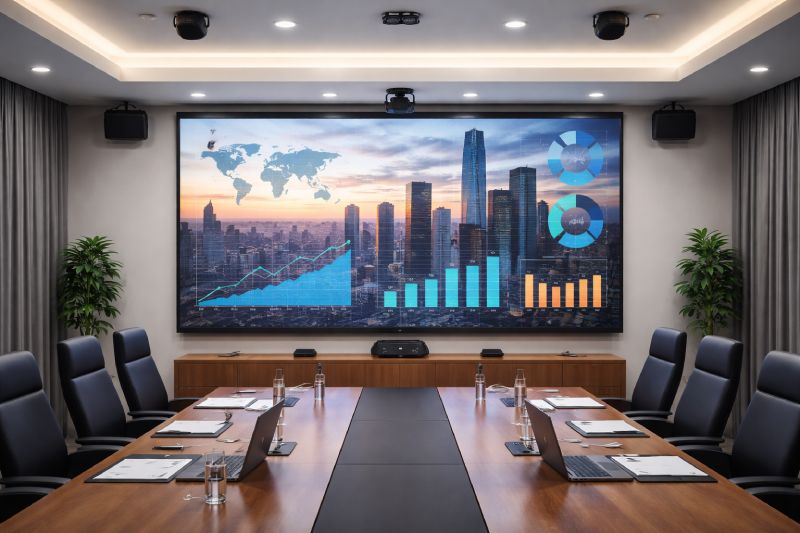
Before diving into specific drivers, it is essential to understand how the AV industry is evolving at a macro level—and why different forecasts sometimes show significant variation.
While headline figures differ across research firms, the overall direction is consistent: stable growth with increasing strategic importance.
This discrepancy reflects a fundamental transformation: the AV industry is no longer just about hardware (displays, audio systems), but increasingly about integrated ecosystems combining hardware, software, and services.
In other words, the definition of “AV market” itself is expanding—which is a growth driver in its own right.
The sustained expansion of the audiovisual market is not driven by a single factor, but by multiple structural shifts happening simultaneously across industries. These drivers reinforce each other, creating a compounding effect on demand.
One of the most persistent forces reshaping AV demand is the normalization of hybrid work.
Organizations are no longer simply installing meeting room equipment—they are building collaboration ecosystems that must support seamless interaction between remote and in-person participants.
This has led to:
As hybrid work becomes permanent, AV systems are evolving into mission-critical enterprise infrastructure, rather than discretionary IT spending.
At the same time, the rise of the experience economy is redefining how AV technologies are used in physical spaces.
Businesses are no longer competing solely on products or services—but on memorable, immersive experiences. This shift is particularly visible in:
In these environments, AV technologies—especially large-format displays and immersive audio—serve as the backbone of storytelling and engagement.
This trend is crucial: it moves AV from a supporting role to a value-creation role, directly impacting revenue generation.
Closely linked to the experience economy is the rapid expansion of digital signage.
As physical spaces become more digitized, static communication is being replaced by dynamic, data-driven visual systems.
Key growth factors include:
High-resolution display technologies—particularly LED—are playing a central role in this shift, enabling:
This is one of the most direct intersections between AV market growth and display technology innovation.
Another important layer of growth comes from immersive technologies, which are expanding the boundaries of traditional AV applications.
Extended Reality (XR), augmented reality (AR), and virtual reality (VR) are increasingly being adopted in:
These technologies elevate AV from “viewing” to participation, fundamentally changing how users interact with content.
As hardware becomes more capable and costs decline, immersive AV is expected to move from niche applications into broader commercial use.
Underpinning all of these trends is a major technological shift: the move toward software-defined AV infrastructure.
Modern AV systems are no longer isolated hardware setups—they are networked, intelligent, and scalable.
Key enablers include:
This transition delivers several strategic benefits:
In effect, AV is converging with IT—reshaping both industries in the process.
While global growth trends are consistent, regional dynamics reveal where the most significant opportunities are emerging—and where competition is intensifying.
Asia-Pacific continues to lead global AV market expansion, driven by:
India, in particular, is emerging as a high-growth market, reflecting broader economic and digital transformation trends.
North America remains the most mature AV market, characterized by:
Growth here is less about expansion and more about upgrading and innovation.
Regions such as the Middle East and Latin America are gaining momentum through:
These markets often adopt cutting-edge AV technologies directly, bypassing legacy systems.
To fully understand the audiovisual market outlook, it is equally important to examine where demand is being generated across industries.
The largest and most stable segment, driven by:
A rapidly evolving segment where AV supports:
One of the fastest-growing segments, fueled by demand for:
Retail is undergoing a transformation where AV becomes central to:
Despite strong growth potential, the AV industry faces several structural challenges that could impact adoption speed and project execution.
These challenges are important—not as barriers, but as factors shaping how the market evolves.
Key constraints include:
Additionally, macroeconomic factors such as interest rates and supply chain dynamics continue to influence purchasing decisions.
Looking ahead, the most significant opportunities lie not just in market expansion—but in new business models and technology convergence.
AV is becoming a core component of smart environments, enabling:
The convergence of AV and media ecosystems is unlocking:
A major shift is underway from CapEx to OpEx models, with growing demand for:
This model lowers entry barriers and accelerates adoption across industries.

The global audiovisual market outlook is defined by a clear transition: from hardware-centric growth to experience-driven, software-enabled ecosystems.
What makes this market particularly compelling is not just its size, but its cross-industry relevance. From enterprise collaboration to immersive entertainment and smart cities, AV technologies are becoming foundational to modern digital experiences.
For industry players, the opportunity is not simply to participate in growth—but to align with the deeper transformation shaping the future of audiovisual technology.

