


Choosing the right display technology is one of the most important decisions in any audiovisual project. Today, most buyers compare dvLED vs LCD. Both are mature solutions. Both serve different needs.
Many articles reduce this choice to cost or image quality. That approach is misleading. The real differences run much deeper. They involve brightness behavior, contrast physics, lifespan, scalability, system design, and long-term ownership value.
This guide explains those differences clearly. It focuses on how these technologies behave in real environments. It also explains when each one makes sense.
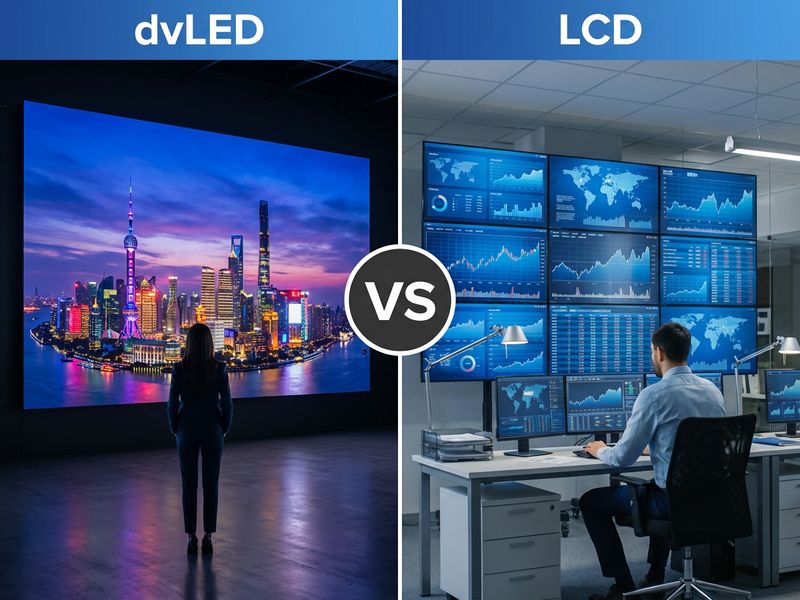
dvLED stands for direct-view LED. Each pixel emits its own light. There is no backlight.
LCD stands for Liquid Crystal Display. It uses a backlight. Liquid crystals block or allow that light to pass.
This structural difference shapes everything that follows.
Brightness is not a marketing number. It determines whether a display works in a given space.
Most commercial LCD video wall panels operate at 500–700 nits. Some high-brightness models reach 1,000 nits, but they cost more and generate more heat.
Indoor dvLED systems typically operate between 1,200 and 2,000 nits. Outdoor systems often exceed 5,000 nits.
Now consider the environment.
In bright spaces, LCD screens lose contrast. Blacks become gray. Colors fade. Fine details disappear.
dvLED performs much better. Higher brightness and stronger contrast preserve readability. Content stays visible even under strong ambient light.
This is why dvLED dominates in:
Contrast defines how much depth an image has.
LCD relies on a backlight. Even when a pixel tries to show black, some light leaks through. This raises the black level.
Local dimming can help. But it cannot control light at the pixel level.
dvLED pixels turn completely off. This produces true black.
This difference improves:
In broadcast studios and simulation rooms, this matters a lot.
Many people say dvLED has “better color.” That is vague.
The real issue is color volume.
As brightness increases, many LCDs lose saturation. Whites dominate. Colors appear washed out.
dvLED maintains color intensity at high brightness. This is critical for HDR content and large-format displays.
This is one reason dvLED is common in premium brand environments.
LCD video walls use individual panels. Even ultra-narrow bezel models show visible borders. These borders often measure 0.44–1.8 mm.
When many panels connect, the grid becomes obvious.
This grid can:
dvLED modules connect without visible seams. The display becomes a continuous canvas.
This is why dvLED is preferred for:
LCD panels offer high pixel density in small sizes. A 4K 55-inch panel packs many pixels into a compact area.
This makes LCD ideal for close-range viewing.
dvLED resolution depends on pixel pitch. A 1.2 mm pitch looks sharp at 2–3 meters. A 2.5 mm pitch suits longer distances.
Fine-pitch dvLED is expensive. If viewers sit close, LCD often delivers better value.
LCD backlights degrade over time. Brightness drops. Colors shift.
Typical LCD lifespans range from 30,000 to 50,000 hours.
dvLED systems often exceed 80,000 to 100,000 hours.
If a display runs 24/7, dvLED often offers better long-term value.
LCD panels generate heat from their backlights. High-brightness models consume more power.
dvLED distributes heat across a larger surface. It also produces light more directly.
This can reduce cooling requirements in large installations.
LCD walls scale by adding panels. But as size increases:
dvLED scales naturally. A 3-meter wall and a 30-meter wall follow the same design logic.
This makes dvLED ideal for very large formats.
LCD walls are flat rectangles.
dvLED can:
This flexibility supports experiential design.
In mission-critical environments, failure is not an option.
dvLED systems can support:
Most LCD walls do not offer this level of system resilience.
LCD panels are easy to replace. One panel fails, and you swap it.
dvLED modules are also replaceable, but color calibration is more complex.
For small teams, LCD feels simpler. For large systems, dvLED offers better uptime.
Not all content benefits from dvLED.
LCD is better for:
dvLED excels at:
Ask five questions.
The answers will guide you.
There is no universal winner in the dvLED vs LCD debate.
dvLED delivers scale, brightness, and immersion.
LCD delivers precision, affordability, and simplicity.
The best audiovisual systems match technology to purpose.
When that alignment is right, performance improves. So does ROI.

