


SiliconCore made waves at InfoComm 2026 by debuting an industry-changing innovation: the world’s first native touch LED display. Developed alongside interactive tech specialist BrightLogic, this new dvLED solution delivers built-in infrared touch functionality straight from the display’s core driver chips. As a result, it breaks free from the limits of traditional add-on touch frames. The live demo featured a 2.6mm pixel pitch native touch LED display and a sprawling 1.2mm pixel pitch LED floor canvas. Impressively, it is capable of 16ms touch response, unlimited simultaneous touch points, and seamless scaling across 32K ultra-wide display surfaces.
This game-changing native touch LED display is built around SiliconCore’s proprietary RGB+1 driver chip paired with BrightLogic’s TouchController Pro platform. Unlike retrofitted touch LED walls that separate display and touch hardware, the integrated IR circuitry inside each driver module turns every LED panel into a naturally interactive surface from production. In addition, the modular dvLED design keeps premium image quality intact. It also unlocks immersive use cases for experience centres, corporate lobbies, simulation labs, command control rooms and entertainment venues.
Company leadership highlighted strong on-site feedback from trade show attendees, signalling surging market demand for high-resolution, fully integrated interactive LED visuals. SiliconCore CEO Eric Li stated the RGB+1 chip architecture creates a new generation of responsive, modular interactive displays. Also, BrightLogic CEO John Scarpa noted the joint solution solves long-standing scalability and precision pain points for large-format interactive installations.
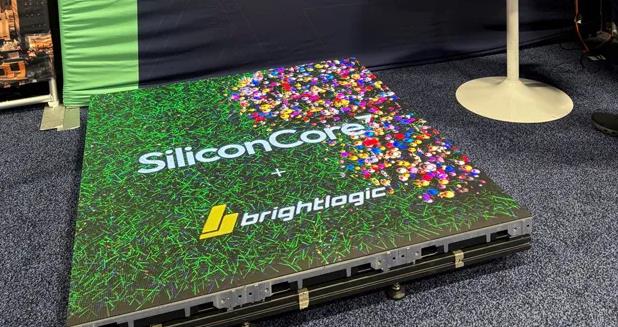
The world’s first native touch LED display stands apart from existing interactive LED products thanks to its chip-level integrated touch architecture, rather than external add-on hardware. Notably, all touch sensing logic is embedded within the display’s core circuitry. This eliminates the need for bulky peripheral infrared borders found on standard touch LED screens.
During the InfoComm demonstration, the technology delivered measurable, industry-leading performance metrics:
Most commercial interactive LED setups rely on aftermarket infrared touch frames, a design that creates consistent flaws in appearance, responsiveness and image fidelity. However, the native touch LED display’s built-in architecture resolves these issues across four critical categories.
Conventional touch LED screens operate as two disconnected systems: LED panels solely handle visual output, while separate border-mounted infrared transmitters and receivers add touch capability post-production. In this design, touch and display signals run independently. This creates sync delays on large spliced walls.
A native touch LED display integrates infrared touch driving circuits directly inside the RGB+1 driver chips during manufacturing. Every LED module ships with native touch functionality, unifying touch detection and image rendering under one shared hardware backbone. No extra frame attachments are required.
External infrared frames create raised, visible borders around regular touch LED screens, preventing fully seamless splicing. These protrusions create distracting visual gaps, especially damaging for floor LED interactive surfaces and ultra-wide 32K video walls.
Native touch LED panels have completely flat, unobstructed surfaces. Additionally, multiple modules can be joined to form continuous, borderless interactive canvases. This makes them ideal for both vertical display walls and ground LED immersive installations.
Traditional frame-based touch systems suffer signal desync across large screen arrays, leading to lag, touch position drift and limited simultaneous touch points. Moreover, heavy ambient light or dust also triggers frequent false touch inputs.
The unified signal processing of a native touch LED display maintains steady 16ms response speeds across full 32K wide canvases. It supports unlimited simultaneous touches with consistent precision. Therefore, it meets strict accuracy standards for simulation training and multi-person collaborative workspaces.
Add-on touch frames and overlay infrared grids introduce light reflection and visual obstruction, gradually reducing LED clarity and brightness over long-term commercial use. Furthermore, dust accumulation around frame hardware worsens false touch detection over time.
Native touch LED display hardware contains no obstructive external components, fully preserving the original colour gamut and brightness performance of dvLED panels. On-chip infrared sensing delivers stronger resistance to dust and strong ambient light. As a result, it sustains stable visuals for round-the-clock venue and control centre deployment.
As the world’s first native touch LED display to launch on the professional AV market, SiliconCore and BrightLogic’s joint innovation addresses a pervasive industry tradeoff. Previously, brands had to sacrifice seamless aesthetics, touch speed or picture quality to add interactivity to large LED walls.
By embedding touch functionality as a core native feature of the display hardware, this new technology balances modular expandability, instant touch feedback and broadcast-grade visual performance. Meanwhile, rising investment in immersive exhibition spaces, digital corporate showrooms and smart command infrastructure positions integrated native touch LED display solutions as a dominant interactive display trend moving forward.
SiliconCore’s debut of the world’s first native touch LED display at InfoComm 2026 marks a pivotal leap for large-format interactive dvLED technology. When compared against conventional frame-fitted touch LED screens, the native touch LED display delivers cleaner aesthetics, faster response, seamless large-scale splicing and uncompromised image quality. This fully integrated solution establishes a new benchmark for interactive visual experiences across commercial, entertainment and industrial control environments.

