


A next-generation interactive LED display is redefining how students engage with technology and self-expression—blending real-time data, AI-driven visuals, and emotional input into a shared digital experience.
At Westminster Schools in Atlanta, a newly launched innovation hub is already attracting attention—not just for its advanced facilities, but for a striking interactive LED wall that transforms human emotions into dynamic visual art.
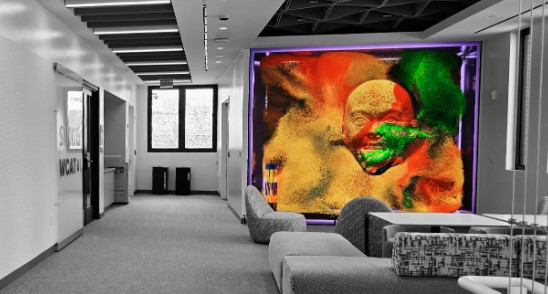
Installed inside the school’s newly developed Blake Innovation Center, the LED video wall goes beyond conventional display applications. Rather than simply presenting content, it actively invites participation, encouraging students and staff to reflect on their emotional state and see it visualized in real time.
The concept is rooted in a hybrid educational philosophy: combining STEM disciplines with creative exploration and emotional awareness. Users interact with a nearby touchscreen kiosk, selecting from a range of emotional states or capturing a selfie, which then triggers personalized visual outputs on the LED canvas.
This approach reframes the LED display as more than a communication tool—it becomes a collaborative, data-driven art platform.
The installation was designed by Fusion CI Studios and built using dvLED technology from SNA Displays. Behind the scenes, a sophisticated software stack drives the experience, including:
Together, these technologies enable the display to react instantly to user inputs, producing evolving, color-coded imagery that reflects both individual and group emotional states.
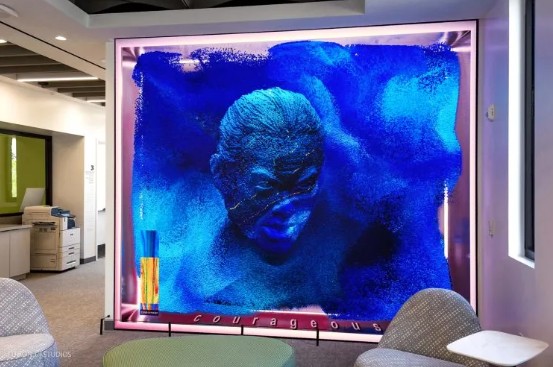
One of the most distinctive aspects of the installation is its ability to aggregate inputs over time. As users continue to interact with the system, it builds a real-time emotional dataset, visualizing the collective mood of the space.
This creates a constantly shifting digital atmosphere—one that mirrors the psychological energy within the building. It also introduces students to concepts such as data visualization, human-computer interaction, and AI-driven content generation in a highly tangible way.
From a hardware perspective, the LED wall is engineered for precision and clarity in a close-viewing environment. It features:
This configuration ensures that even subtle visual effects—such as particle motion and color gradients—are rendered with high fidelity, which is critical for immersive, interactive installations.
The Blake Innovation Center itself supports a wide range of disciplines, including 3D animation, robotics, broadcast production, and programming. The addition of this interactive LED installation reinforces a broader trend: LED displays are evolving into experiential platforms, particularly in educational environments.
Rather than serving purely informational or decorative roles, they are increasingly being used to:
This project illustrates a clear shift in how LED technology is being deployed. By integrating interactivity, AI, and real-time rendering, the installation transforms a standard LED wall into a responsive, human-centered interface.
For schools and institutions investing in next-generation learning environments, this kind of application demonstrates the potential of LED displays—not just as screens, but as immersive platforms for expression, analysis, and connection.

