


Travelers arriving at George Bush Intercontinental Airport in Houston are now welcomed by a striking new digital landmark suspended above the terminal concourse.
Known as “Oculus,” the installation takes the form of a sweeping 69-meter elliptical LED structure that functions both as a large-scale media display and as an architectural centerpiece within the airport environment.
Positioned between the arrivals and departures levels and tilted at a 60-degree angle, the installation is visible from multiple vantage points throughout the terminal, allowing passengers on both floors to experience its dynamic visuals as they move through the space.
Rather than serving as a conventional information screen, the structure transforms the ceiling of the concourse into an immersive digital canvas.
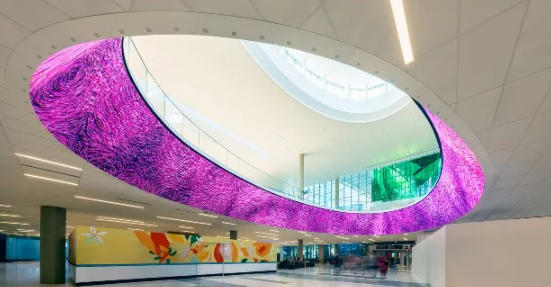
Unlike traditional flat LED video walls used for airport digital signage, the Oculus installation adopts the form of a truncated elliptical cone, creating the impression of a floating digital sculpture suspended above the concourse.
The display measures approximately 28 meters in length and nearly 5 meters in height, while its curved structure stretches to a total span of 69 meters. In total, the installation covers about 182 square meters of LED display surface.
Its sweeping geometry makes the installation visible from multiple angles across the terminal, transforming the space into a visually engaging environment rather than a purely functional transit area.
As travelers pass beneath the structure, the curved LED surface creates a continuous visual experience that unfolds across the concourse.
Creating the elliptical structure required extensive engineering beyond the capabilities of standard LED display systems.
Conventional rectangular LED cabinets could not accommodate the precise curvature required by the design. To achieve the smooth arcs of the installation, engineers produced more than 2,000 custom-fabricated LED modules, each designed specifically for the project.
Many of the modules were manufactured with slightly trapezoidal geometries, allowing them to align seamlessly along the curved structure while preserving consistent pixel spacing across the display surface.
To simplify construction and long-term servicing, the installation was divided into eight arc segments, each assembled from dozens of specially designed LED panels. The final structure incorporates nine unique frame designs and 84 custom structural frames that together form the continuous elliptical surface.
The result is a seamless LED canvas that maintains its sculptural form while delivering high-resolution digital imagery.
Despite its unconventional shape, the installation delivers impressive visual performance suitable for close viewing inside the busy terminal environment.
The display achieves a resolution of 34,584 by 1,416 pixels, totaling nearly 49 million pixels across the curved LED surface.
Pixel pitch ranges between 1.4 mm and 2.0 mm, enabling detailed visuals for passengers walking directly beneath the structure. Brightness levels have been calibrated to approximately 800 nits, ensuring clear visibility within the brightly lit airport interior.
During production, each LED module was color-matched at the factory to maintain consistent image quality across the complex curved geometry.
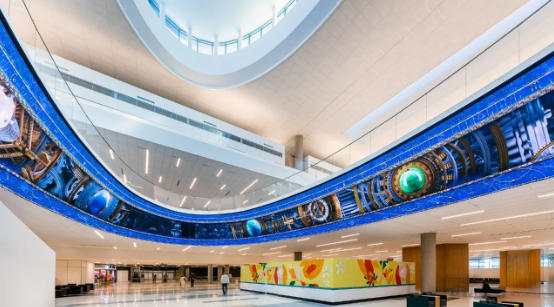
Large-scale digital installations in transportation hubs must be engineered for continuous operation and efficient maintenance.
The modular LED system used in the Oculus installation supports front-service access, allowing technicians to replace individual panels without removing surrounding sections. This capability is particularly important in an airport terminal where maintenance must be performed with minimal disruption to passenger traffic.
Thermal management systems were also integrated into the design to support reliable operation despite Houston’s hot and humid climate.
Before full production began, engineers constructed a full-scale prototype to validate the mounting structure, panel alignment, and image performance across the curved display.
Beyond its architectural presence, the Oculus installation also serves as an interactive storytelling platform designed to introduce travelers to the identity of the city.
The display presents 27 visual sequences that interpret Houston’s landscapes, culture, and technological heritage. Several sequences reference the city’s historic role in human space exploration, reinforcing Houston’s global reputation as a center of aerospace innovation.
Motion sensors installed within the concourse detect passenger movement and translate it into real-time visual responses on the LED surface. As travelers walk beneath the structure, the display subtly reacts to their presence, creating an interactive digital experience within the terminal environment.
The Oculus project reflects a broader trend in airport design, where digital displays are increasingly being integrated into architecture rather than treated as standalone signage.
Large LED installations are now being used to create immersive environments, communicate a city’s cultural identity, and provide memorable visual experiences for travelers.
Unlike traditional airport screens used primarily for advertising or flight information, architectural LED displays are designed to function as both media platforms and spatial design elements.
For airports competing to enhance passenger experience and strengthen their brand identity, installations like Oculus demonstrate how digital display technology can transform transit spaces into visually engaging destinations.
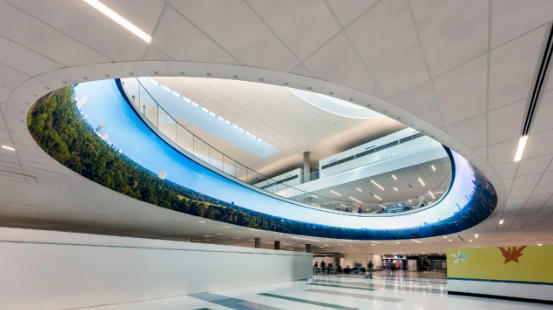
Suspended above one of the busiest areas of the terminal, the 69-meter elliptical LED “Oculus” introduces visitors to Houston with a bold visual statement.
For arriving passengers, it offers an immediate sense of place. For departing travelers, it becomes one of the final impressions of the city.
By combining architectural design, interactive media, and advanced LED display technology, the installation transforms a functional airport concourse into a dynamic digital environment.

