


Interactive LED floors have become one of the most engaging digital display solutions for modern entertainment, retail, exhibitions, museums, and live events. Unlike traditional LED floor displays, they respond to people’s movements in real time, transforming ordinary spaces into immersive and interactive experiences.
Whether visitors walk across a virtual river, trigger animated flowers beneath their feet, or participate in interactive games, an interactive LED floor creates memorable experiences that increase audience engagement and attract attention.
However, building an interactive LED floor involves much more than installing LED panels. A complete system combines display hardware, motion detection technology, media servers, software, and precise calibration to ensure smooth and responsive interaction.
In this guide, you’ll learn how to create an interactive LED floor step by step, including the hardware components you need, how the system works, installation best practices, common challenges, and tips for choosing the right solution for your project.
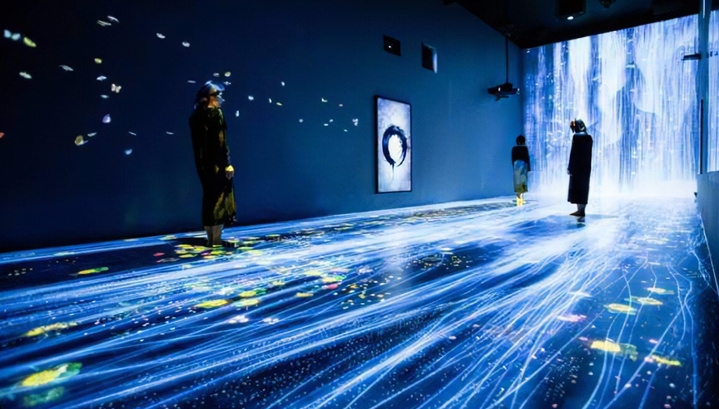
Interactive LED floor increases mysterious atmosphere in stage performance.
An interactive LED floor is an LED floor display integrated with interactive sensing technology and specialized control software. Unlike a standard LED floor that only plays videos or images, an interactive LED floor reacts instantly to movement, touch, or gestures, creating dynamic visual effects based on user actions.
The system typically combines several technologies, including:
When someone walks across the display, the sensors detect their position and immediately send data to the control system. The software then generates corresponding animations, games, or visual effects that appear directly beneath the user’s feet.
This real-time interaction transforms passive digital signage into an engaging experience that encourages visitors to participate rather than simply observe.
Because of its versatility, an interactive LED floor system is widely used in:
Compared with traditional LED floor displays, interactive systems deliver significantly higher audience engagement and create stronger brand impressions.
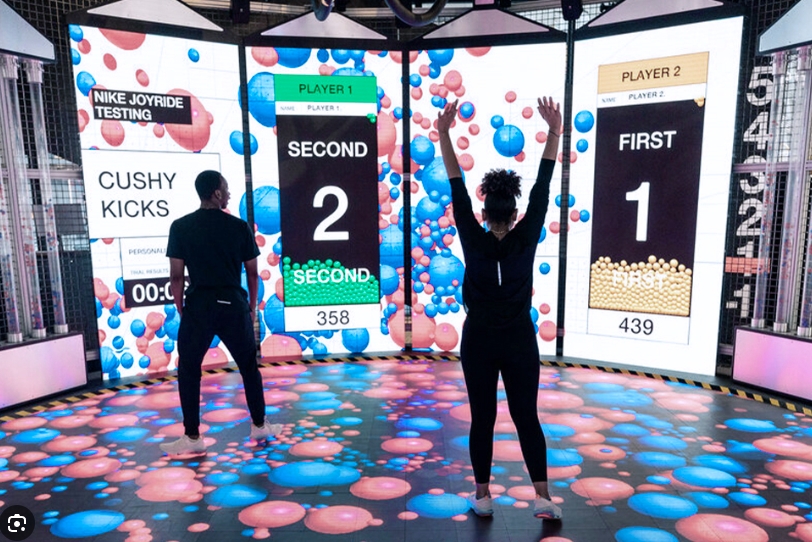
Interactive LED floor can be applied at interactive games.
Understanding how an interactive LED floor works makes it easier to design a reliable system.
Although different manufacturers use different technologies, the basic workflow remains the same.
Interactive Workflow
Person walks on the floor → Interactive sensor detects movement → Sensor sends position data → Interactive software analyzes the movement → Media server generates visual effects → LED controller updates the display → LED floor responds instantly
The key to a successful interactive LED floor is minimizing response latency.
High-quality systems typically respond within milliseconds, creating a smooth and natural interactive experience without noticeable delays.
Several sensing technologies can be used depending on the application:
| Sensor Type | Best Applications | Advantages |
| Infrared Sensors | Shopping malls | Accurate, stable, cost-effective |
| Pressure Sensors | Interactive games | Direct physical interaction |
| Motion Tracking Cameras | Museums, exhibitions | Contactless interaction |
| Radar Sensors | Public spaces | Long detection range |
| LiDAR Sensors | Premium projects | High precision and multi-person tracking |
Selecting the right sensor technology depends on the installation environment, expected visitor traffic, budget, and desired interactive effects.
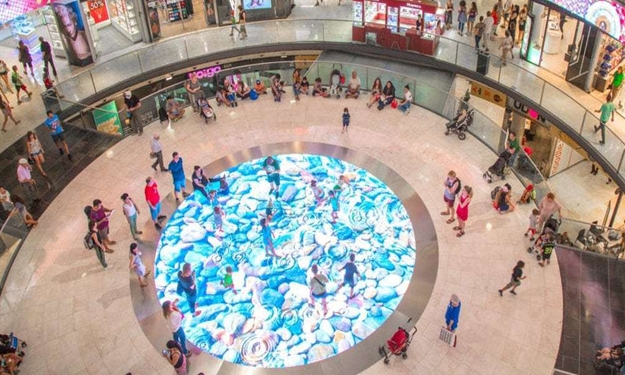
Interactive LED floor attracts visitors at shopping mall.
Creating a professional interactive LED floor requires much more than LED panels alone. Each component plays an important role in ensuring smooth operation and long-term reliability.
LED floor panels form the display surface where all interactive content is presented.
Unlike conventional LED cabinets, floor panels are specifically engineered to withstand continuous foot traffic and heavy loads. High-quality panels typically feature:
When selecting LED floor panels, consider factors such as pixel pitch, brightness, IP rating, cabinet strength, maintenance method, and installation environment.
Sensors are responsible for detecting user movement.
Depending on the application, the system may use infrared sensors, pressure sensors, motion tracking cameras, or radar technology.
The accuracy of these sensors directly affects the responsiveness and realism of the interactive experience.
The LED control system receives image data from the media server and distributes it to each LED panel.
A stable control system ensures synchronized playback, smooth animations, and accurate color reproduction across the entire floor.
The media server acts as the processing center of the interactive LED floor system.
It receives movement data from the sensors, processes interactive logic, and generates the visual content displayed on the LED floor.
More advanced projects often use high-performance media servers capable of handling multiple interactive effects simultaneously while maintaining low latency.
Interactive software connects sensor input with digital content.
It determines how the LED floor responds when users move across the display.
Common interactive effects include:
Modern software platforms also support customized applications for exhibitions, education, museums, and commercial marketing campaigns.
A reliable supporting structure ensures that the LED floor remains level, stable, and safe under continuous use.
The power distribution system should provide sufficient capacity while protecting the equipment from voltage fluctuations and ensuring long-term operational stability.
Proper cable management, ventilation, and maintenance access should also be considered during the planning stage.
Building an interactive LED floor requires careful planning, proper hardware selection, and accurate system integration. Following a structured installation process helps ensure reliable performance, smooth interaction, and long-term stability.
Before purchasing any equipment, clearly define your project objectives.
Ask yourself the following questions:
For example, an LED floor for a shopping mall focuses on attracting customers with engaging visual effects, while a stage performance may prioritize synchronized graphics and high refresh rates for professional video recording.
A clear project plan helps you choose the right hardware from the beginning and prevents unnecessary redesign later.
Choosing the right LED floor panels is one of the most important decisions when building an interactive LED floor. Besides durability and load-bearing capacity, pixel pitch is one of the key factors that determines both image quality and project cost.
Unlike conventional LED video walls, interactive LED floors are typically viewed by people standing directly on or near the display. Because the viewing distance usually remains within a person’s natural standing height, selecting a pixel pitch based solely on viewing distance is not the most practical approach.
Instead, consider the following factors when selecting the appropriate pixel pitch:
For most indoor interactive LED floor projects, P2.6 to P2.97 provides an excellent balance between image quality, durability, and cost. Projects that require premium visual performance—such as luxury retail stores, museums, or experience centers displaying detailed graphics or branding—may benefit from P1.95. For large exhibition halls, stages, and rental events where the display is viewed over a wider area, P3.91 remains a popular and cost-effective choice.
| Pixel Pitch | Recommended Applications |
| P1.95 | Luxury retail, museums, premium experience centers, high-end brand displays |
| P2.5–P2.97 | Most indoor interactive LED floor installations, shopping malls, exhibitions, corporate lobbies |
| P3.91 | Stage performances, rental events, large exhibition halls, temporary installations |
Rather than automatically selecting the finest pixel pitch, focus on choosing the specification that best matches your application’s visual requirements and overall project budget. In many cases, a well-designed P2.6 or P2.97 interactive LED floor delivers an excellent user experience while providing a more cost-effective solution.
| Specification | Recommendation |
| Brightness | 800–1,500 nits for most indoor applications; higher brightness may be required for spaces with strong ambient lighting. |
| Load Capacity | Select panels designed to withstand continuous pedestrian traffic and concentrated loads. |
| Refresh Rate | ≥3,840 Hz for smooth motion, professional video recording, and flicker-free camera performance. |
| Protection Rating | IP54 or higher for indoor environments; IP65 or above for outdoor installations. |
| Surface Finish | Choose anti-slip, wear-resistant surfaces to improve safety and extend service life. |
| Maintenance Method | Front maintenance is generally preferred because it simplifies servicing and reduces downtime. |
Besides pixel pitch, several additional specifications should also be evaluated.
Expert Tip:
Since users stand directly on an interactive LED floor, their attention is typically focused on the interactive effects rather than individual pixels. For applications such as water ripples, footprints, flowers, games, and motion-triggered animations, P2.6 or P2.97 usually provides sufficient visual performance. A finer pixel pitch becomes more valuable when the display needs to present detailed branding, product imagery, text, or high-resolution artistic content.
An efficient layout improves installation quality and simplifies future maintenance.
During the design stage, consider:
If the project includes irregular shapes or curved walkways, design custom cabinet layouts before manufacturing begins.
Professional planning reduces installation time and minimizes future maintenance costs.
Once the supporting structure is complete, install the LED floor panels according to the manufacturer’s guidelines.
During installation:
Even a small height difference between adjacent cabinets can affect walking comfort and reduce the visual quality of the display.
After installation, inspect the entire surface carefully to ensure it is flat, stable, and safe for public use.
The sensor system determines how accurately the LED floor responds to user movement.
Several sensing technologies are available, each with different strengths.
| Sensor Technology | Advantages | Recommended Applications |
| Infrared Sensors | Fast response and cost-effective | Shopping malls, exhibitions |
| Pressure Sensors | Direct contact detection | Interactive games |
| Camera Tracking | Supports multiple users | Museums and experience centers |
| Radar Sensors | Long detection distance | Large public spaces |
| LiDAR | Extremely high precision | Premium interactive projects |
Sensor placement is equally important.
Improper installation may result in:
After installation, calibrate the detection area to ensure accurate tracking across the entire floor.
The LED control system acts as the communication hub between the media server and the LED display.
Typical system architecture includes:
Media Server → Video Processor → Sending Controller → Receiving Cards → LED Floor Panels
Verify that:
A properly configured control system ensures synchronized playback and stable performance.
Interactive software transforms movement data into engaging visual effects.
Depending on your project, you can create experiences such as:
Many modern software platforms also support gesture recognition, AI-assisted interaction, and multi-user tracking for more immersive experiences.
The software should be optimized to maintain low latency while delivering smooth animations.
Before opening the installation to the public, perform comprehensive testing.
Use the following checklist:
✔ Check every LED cabinet.
✔ Verify color consistency.
✔ Test brightness uniformity.
✔ Confirm all sensors respond correctly.
✔ Walk across every section of the floor.
✔ Verify interactive accuracy.
✔ Test emergency shutdown procedures.
✔ Monitor operating temperatures.
✔ Run continuous operation tests.
Testing under real operating conditions helps identify issues before they affect visitors.
Routine maintenance extends the service life of your interactive LED floor and keeps it operating reliably.
Preventive maintenance is generally more cost-effective than repairing unexpected failures after installation.
Many buyers wonder whether an interactive LED floor is worth the additional investment. The answer depends on the application’s goals.
| Feature | Interactive LED Floor | Traditional LED Floor |
| Displays Images and Videos | ✓ | ✓ |
| Responds to User Movement | ✓ | ✗ |
| Interactive Games | ✓ | ✗ |
| Visitor Engagement | Excellent | Moderate |
| Brand Experience | Excellent | Good |
| Installation Complexity | Higher | Lower |
| Software Requirements | Advanced | Basic |
| Initial Investment | Higher | Lower |
If your objective is simply to display promotional videos, a traditional LED floor may be sufficient. However, if you want visitors to interact with the content, spend more time at your venue, and create memorable experiences, an interactive LED floor offers significantly greater value.
Selecting the appropriate sensor technology depends on your project requirements rather than choosing the most advanced option.
When evaluating sensor systems, prioritize accuracy, response time, scalability, ease of calibration, and long-term reliability over specifications alone.
Interactive LED floors are widely used across industries because they combine visual impact with real-time audience interaction. By turning passive viewers into active participants, they create memorable experiences that traditional displays cannot match.
Interactive LED floors attract shoppers, increase foot traffic, and encourage visitors to spend more time in retail spaces. Popular effects include water ripples, blooming flowers, and branded animations triggered by footsteps.
Museums use interactive LED floors to create immersive educational experiences. Visitors can explore digital maps, interact with historical content, or play educational games that make learning more engaging.
At exhibitions, interactive LED floors help exhibitors stand out in crowded venues. Customized animations, product demonstrations, and interactive brand experiences naturally attract more visitors to the booth.
Concerts, theaters, and television studios use interactive LED floors to synchronize visual effects with performers’ movements, creating spectacular stage productions.
Interactive floors enhance product launches, conferences, annual meetings, and brand activations by providing immersive experiences that leave lasting impressions.
Theme parks increasingly integrate interactive LED floors into attractions, allowing visitors to interact with virtual environments, games, and storytelling experiences.
Compared with conventional digital displays, an interactive LED floor offers several advantages.
People naturally interact with responsive content. This increases participation and encourages visitors to stay longer.
Interactive displays create emotional connections that improve brand recall and social media sharing.
Software can be updated at any time to support seasonal campaigns, promotional events, educational programs, or customized brand experiences.
A single interactive LED floor can support advertising, entertainment, exhibitions, educational activities, and live events.
With high-quality LED floor panels, proper installation, and routine maintenance, interactive LED floor systems can operate reliably for many years.
Even premium hardware cannot compensate for poor planning or incorrect installation. Avoid these common mistakes to improve long-term reliability.
A smaller pixel pitch is not always better. Select the resolution based on the expected viewing distance and project budget.
The supporting structure must safely withstand continuous pedestrian traffic and concentrated loads.
Disorganized power and signal cables increase maintenance difficulty and may affect system stability.
Improper calibration can result in delayed responses, inaccurate tracking, or uneven interactive effects.
Media servers, processors, and power supplies generate heat during operation. Ensure sufficient airflow to maintain stable performance.
Design the installation so technicians can easily replace panels, inspect cables, and service electronic components without dismantling the entire floor.
There is no universal price for an interactive LED floor because every project has unique technical requirements.
The total investment depends on several factors:
| Cost Factor | Impact |
| Pixel Pitch | Higher resolution generally increases cost |
| Display Size | Larger floors require more LED panels |
| Interactive Technology | Advanced sensors and tracking systems increase complexity |
| Software Customization | Custom interactive effects require additional development |
| Installation Environment | Indoor and outdoor projects have different structural requirements |
| Control System | Professional media servers and processors improve performance |
| Maintenance Requirements | Service accessibility influences long-term operating costs |
Instead of focusing solely on the initial purchase price, evaluate the system based on its long-term reliability, image quality, maintenance efficiency, and ability to support future content updates.
Selecting the right supplier is just as important as choosing the right hardware.
Look for a manufacturer that offers:
A reliable supplier should also provide engineering drawings, wiring diagrams, software configuration guidance, and operator training to ensure a successful installation.
Interactive LED technology continues to evolve rapidly.
Several emerging trends are shaping the future of the industry.
Artificial intelligence enables smarter interaction by recognizing gestures, behaviors, and visitor patterns.
Advanced sensing technologies allow multiple people to interact simultaneously without affecting system accuracy.
Interactive LED floors are increasingly integrated into XR studios and virtual production environments, enabling seamless interaction between performers and virtual content.
Retailers are combining interactive LED floors with customer analytics to measure engagement and optimize marketing campaigns.
Cloud platforms simplify remote content updates, system monitoring, and multi-location management.
As these technologies mature, interactive LED floors will become even more immersive, intelligent, and easier to manage.
Interactive LED floors use technologies such as infrared sensors, pressure sensors, motion-tracking cameras, radar, or LiDAR to detect user movement. The sensor data is processed by interactive software, which instantly triggers corresponding visual effects on the LED display.
Yes. Commercial LED floor panels are specifically designed for pedestrian traffic and are built with reinforced structures and anti-slip surfaces. Always verify the load-bearing specifications before installation.
Yes, but outdoor installations require weather-resistant LED panels with higher IP ratings, increased brightness, and additional protection against rain, dust, and temperature changes.
Interactive LED floors typically use dedicated interactive software integrated with media servers and sensor systems. The software manages motion detection, content playback, and real-time visual effects.
A high-quality interactive LED floor can typically operate for 50,000 to 100,000 hours, depending on LED quality, operating conditions, and maintenance practices.
Not necessarily. Modern LED floor systems are designed for easy maintenance, especially those with front-service access. Regular cleaning, software updates, and periodic inspections help ensure long-term reliability.
Yes. Most professional systems support fully customized animations, games, branding elements, educational content, and interactive experiences tailored to specific applications.
Interactive LED floors are widely used in retail, museums, exhibitions, entertainment venues, corporate events, television studios, education, theme parks, and sports facilities.
An interactive LED floor is far more than a digital display—it is an immersive platform that transforms the way people engage with spaces, brands, and experiences. By combining durable LED floor panels, responsive sensor technology, reliable control systems, and creative interactive software, you can deliver memorable experiences that capture attention and encourage participation.
Whether you’re designing a retail attraction, planning an exhibition booth, building a stage production, or creating an immersive experience center, success depends on careful planning, selecting the right hardware, and partnering with an experienced supplier.
As interactive technologies continue to advance, investing in a scalable and well-designed interactive LED floor system will help ensure your installation remains engaging, reliable, and future-ready.
If you’re planning an interactive LED floor project, choosing the right technology partner is the first step toward success. An experienced manufacturer can help you select the appropriate LED floor panels, interactive sensing technology, control system, and software based on your venue, application, and budget.
Whether your project is for a shopping mall, exhibition, museum, stage performance, or corporate event, a customized interactive LED floor solution will deliver the best performance, reliability, and long-term value.

