


White LED technology may be entering a new stage of development. Seoul Viosys, an affiliate of Seoul Semiconductor, has developed a white LED chip that produces light without rare earth materials. The new technology is based on the third-generation WICOP 3 architecture and supports chip sizes as small as 10 μm.
The development addresses two long-standing challenges in white LED production: dependence on rare earth materials and limitations in chip miniaturization. It also introduces a package-free structure that could reduce manufacturing costs.
According to the company, the new technology could open up opportunities in both lighting and emerging optoelectronic applications.
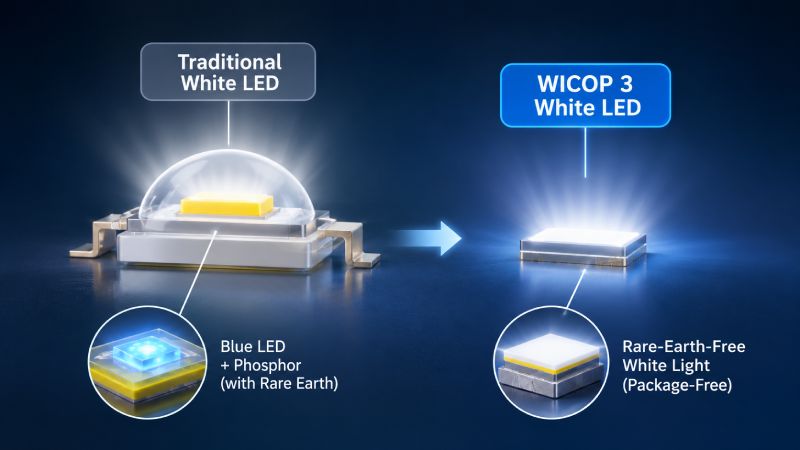
Traditional white LEDs generally use a blue LED chip coated with phosphor materials. Yttrium aluminum garnet (YAG), which contains rare earth elements, is one commonly used phosphor. The phosphor converts part of the blue light into other wavelengths to produce white light.
This approach has supported the development of white LEDs for decades. However, it also creates a dependence on specific materials and requires additional components in the manufacturing process.
Seoul Viosys takes a different approach with WICOP 3. The new technology produces white light without using rare earth materials. The company also describes the chip as a package-free design.
WICOP is a chip architecture developed by Seoul Semiconductor and Seoul Viosys. It removes the conventional LED package, allowing the chip to have a more compact structure. Earlier generations of WICOP technology supported the production of miniature red, green, blue, ultraviolet and infrared LEDs.
WICOP 3 extends this capability to white light. It brings together package-free construction and rare-earth-free white light generation in a single chip architecture.
Chip miniaturization is one of the most notable features of the new technology. Seoul Viosys reports that WICOP 3 can produce white LED chips as small as 10 μm. This is significantly smaller than conventional white LED chips.
The company has also disclosed the performance of its initial mass-produced chips. A chip measuring 25 μm × 10 μm produces 0.015 lumens of white light. Its luminous efficacy is already close to 100 lm/W.
The key specifications and targets include:
| Parameter | Reported Performance |
| Minimum chip size | As small as 10 μm |
| Initial production size | 25 μm × 10 μm |
| Initial luminous efficacy | Nearly 100 lm/W |
| Future efficacy target | 200 lm/W within two years |
| Manufacturing cost | Approximately 50% of conventional white LEDs |
The company aims to improve luminous efficacy to 200 lm/W within two years. It also estimates that the new manufacturing approach can reduce production costs by approximately half compared with conventional white LEDs.
These figures indicate the technology’s potential. However, the 200 lm/W figure remains a development target rather than an achieved production specification. Actual performance will depend on further development and manufacturing conditions.
The ability to produce white light from chips smaller than 100 μm could expand the design possibilities for LED lighting.
One potential application is integrated lighting. Because the chips are extremely small, they could be embedded into materials such as wallpaper and window glass. This may allow lighting to become part of a building’s surfaces rather than relying on conventional fixtures.
The technology could also support future miniaturized optical devices. Smaller light sources offer more flexibility for compact product designs, particularly where space and weight are important.
Seoul Semiconductor also highlights augmented reality (AR) and AI optical communications as promising areas for its WICOP technology family. These applications involve different types of optoelectronic devices, including miniature light sources and optical transmitters. They reflect the broader potential of WICOP technology rather than confirmed applications of the new white LED chip itself.
The introduction of rare-earth-free white LEDs represents a new direction in LED chip development. Its significance goes beyond replacing one material with another.
First, reducing dependence on rare earth materials could give manufacturers an alternative approach to white light generation. It may also help simplify certain parts of the production process.
Second, chip sizes below 100 μm bring white LEDs into the micro-scale range. This could support new product designs that were difficult to achieve with conventional white LED structures.
Third, the package-free architecture may influence future LED manufacturing methods. By removing the traditional package, WICOP 3 offers a different approach to chip integration and product design.
The technology still needs to demonstrate its advantages across a wider range of applications and production conditions. Its long-term impact will depend on manufacturing scalability, product reliability and market adoption.
Nevertheless, WICOP 3 marks an important step in the development of white LEDs. As LED chips continue to become smaller and manufacturing technologies evolve, new opportunities may emerge in lighting, AR devices and optical communications.

