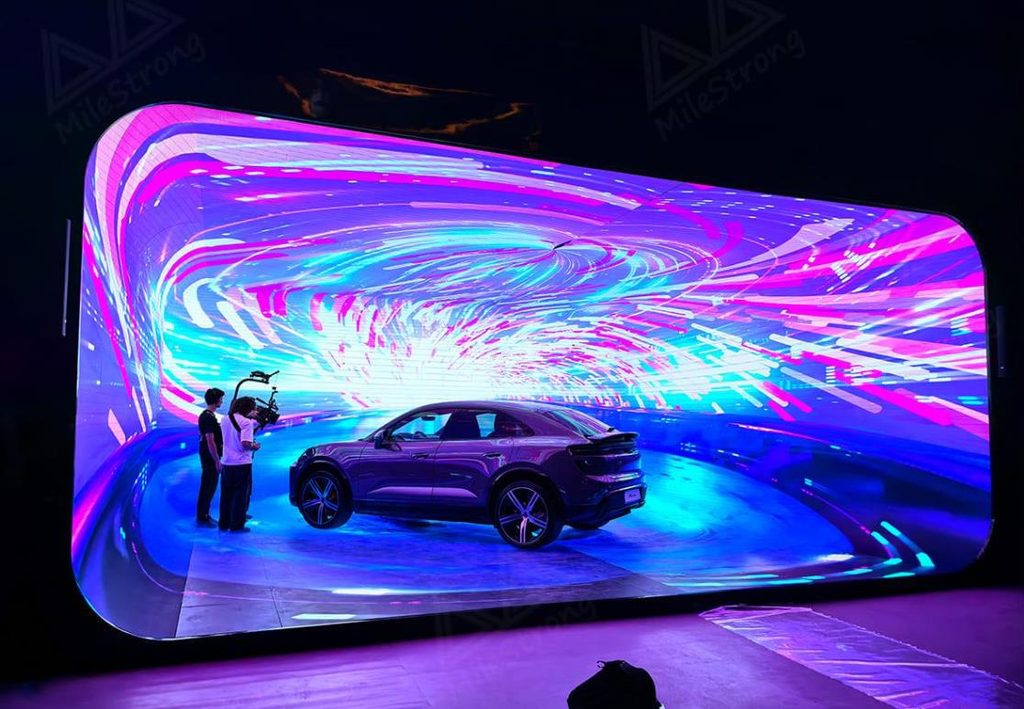
An LED cave creates an immersive visual environment through multiple LED display surfaces. Unlike a conventional LED screen, it surrounds viewers with coordinated images across several directions.
A typical five-sided LED cave consists of three LED walls, an LED floor, and an LED ceiling. One side remains open for access, equipment movement, or other operational needs. This layout creates a strong sense of immersion while keeping the space practical.
LED caves are gaining attention in scientific visualization, virtual reality, simulation, education, and immersive entertainment. They allow users to explore digital environments in a more natural and engaging way.
But how does an LED cave work? What makes its display system different from a conventional LED installation? And what should project planners consider before building one?
This guide explores the design, technology, applications, and key technical requirements of LED cave systems.
An LED cave is a multi-surface display environment designed to place viewers inside a digital visual scene. It uses several synchronized LED screens to create a continuous visual experience across walls, the floor, and the ceiling.
The term CAVE originally refers to a Cave Automatic Virtual Environment. Early CAVE systems used projection technology to display virtual environments on surrounding surfaces. Modern LED-based systems replace projectors with direct-view LED displays.
This change offers several practical benefits. LED screens generate their own light and do not require complex projection paths. They can also provide high brightness, strong contrast, and seamless visual surfaces.
A typical five-sided LED cave has the following structure:
The five display surfaces work together as one visual system. Content can extend from the walls to the floor and ceiling, making the environment feel more spatial and realistic.
However, not every CAVE system uses the same configuration. Some installations use fewer display surfaces, depending on their purpose and technical requirements. This guide focuses on the five-sided LED CAVE configuration.
An LED cave is more than a collection of large LED screens. Its operation depends on coordinated display hardware, content processing, and spatial design.
Each display surface must work with the others. Otherwise, viewers may notice image breaks, color differences, or mismatched movements.
Several key technologies make this coordination possible.
The LED walls, floor, and ceiling form the physical display environment. Each surface displays part of the same visual scene.
The system must maintain consistent image quality across all five surfaces. This includes brightness, color, resolution, and refresh performance.
The physical connections between surfaces also require careful design. Sharp corners can create visible visual interruptions. Custom cabinets and curved transition structures can help create smoother connections.
An LED cave needs a video processing system that can manage multiple display outputs.
The processor or rendering system divides the visual content according to the size and position of each display surface. It then sends the correct image to each screen.
Synchronization is equally important. All surfaces must display their content at the same time. Even small timing differences can affect the viewing experience.
For interactive applications, the system may also need powerful graphics workstations and real-time rendering software.
Many LED cave applications require more than ordinary video playback.
For example, scientific visualization and virtual reality often involve three-dimensional content. The system may use active stereo technology to present different images to the viewer’s left and right eyes.
Tracking systems can also detect the viewer’s position and movement. The rendering software then adjusts the perspective to match the viewer’s location.
This creates a more natural sense of depth and spatial presence.
Projection-based CAVE systems have been used in virtual reality and scientific visualization for many years. However, direct-view LED technology offers an alternative for projects that require high brightness, compact installation, and flexible display design.
The main differences include:
LED displays generate light directly. They can provide high brightness and strong contrast, even in environments with some ambient light.
Projection systems depend on projected light. Their image quality can be affected by ambient light, screen materials, and the projection environment.
Projection-based systems often need projectors, lenses, mirrors, and optical paths.
These components can increase installation complexity and require additional space.
LED displays can be mounted directly onto supporting structures. This can simplify the physical layout and reduce the space needed for projection equipment.
LED displays offer high resolution and direct light emission. They can also provide consistent brightness and color across multiple display surfaces when properly calibrated.
However, achieving uniform image quality still requires careful LED selection, display calibration, and system adjustment.
Projection systems may require regular maintenance of light sources, optical components, and projection equipment.
LED systems have a different maintenance structure. Individual cabinets or display components can often be serviced or replaced without dismantling the entire installation.
The actual maintenance requirements depend on the system design and installation conditions.
LED cabinets support different sizes, shapes, and installation layouts. Custom structures can also help connect walls, floors, and ceilings.
This makes LED technology suitable for projects with specific spatial requirements.
Neither technology is ideal for every project. The final choice should depend on the required image quality, available space, budget, maintenance plan, and application.
LED caves can support a wide range of applications. Their value comes from placing users inside a coordinated digital environment rather than presenting images on a single screen.
Scientific research often involves complex data that is difficult to understand through conventional monitors.
An LED cave can display large-scale 3D models, simulation results, and spatial data across multiple surfaces.
Researchers can explore structures from different perspectives. This is useful in engineering, architecture, urban planning, and scientific visualization.
LED caves can create realistic environments for training and simulation.
Users can interact with digital scenes while viewing them across surrounding display surfaces. Applications include equipment operation, industrial training, vehicle simulation, and architectural walkthroughs.
Tracking technology can further improve the experience by adjusting the visual perspective according to user movement.
Theme parks and entertainment venues use LED caves to create large-scale visual attractions.
Visitors can experience digital landscapes, animated environments, and interactive content within a shared space.
LED floors and ceilings add more visual dimensions than conventional wall-mounted displays. They can make the experience feel more complete and engaging.
Museums and exhibition centers can use LED caves to present historical scenes, cultural content, and educational information.
For example, visitors can explore a reconstructed historical environment or view a large-scale digital representation of a natural landscape.
The multi-surface layout allows exhibition designers to create more engaging storytelling experiences.
Educational institutions can use LED caves to explain complex subjects through visual interaction.
Students can explore scientific models, geographical environments, and engineering structures in a shared digital space.
Professional training centers can also use them to simulate real-world working conditions.
Building an LED cave requires more than selecting LED screens. The display system, physical structure, content, and user experience must work together.
Here are several important factors to consider.
Pixel pitch is one of the most important factors in LED cave design.
Unlike conventional LED screens, an LED cave may place viewers close to several display surfaces. This makes pixel density especially important.
A smaller pixel pitch can provide higher resolution and clearer images at short viewing distances. However, it also increases the display cost.
Project planners should consider the viewing distance, screen dimensions, and required image resolution before choosing a suitable pixel pitch.
An LED cave uses multiple display surfaces within one visual environment.
Differences in brightness or color between the walls, floor, and ceiling can interrupt the visual experience.
Therefore, all surfaces should maintain consistent brightness and color performance.
Proper LED selection, calibration, and display adjustment are essential.
Users may look at the screens from different positions and directions.
LED displays with suitable viewing angles help maintain consistent colors and brightness across the viewing area.
This is particularly important for side walls and floor displays, where viewers may not always face the screens directly.
The LED floor has different requirements from conventional wall-mounted displays.
It must support the weight of visitors and withstand repeated foot traffic. At the same time, it needs to maintain stable display performance.
Protective surfaces may also be necessary to reduce scratches and physical damage.
The floor structure, cabinet strength, heat dissipation, and maintenance access should all be considered during planning.
The LED ceiling introduces additional structural requirements.
Its supporting frame must safely carry the weight of the display system. Installation and maintenance also need careful planning.
The ceiling layout should consider ventilation, cable routing, power distribution, and access for servicing.
Some LED cave projects involve fast-moving content or stereoscopic 3D visualization.
A suitable refresh rate can help reduce visible flicker and improve the viewing experience. However, refresh rate alone does not determine image quality.
The video processor, rendering system, display scan design, and synchronization settings also matter.
The display structure determines how visual content should be created and processed.
Content must match the geometry and resolution of each display surface. Otherwise, images may appear distorted or disconnected at the corners.
For interactive projects, the system may also require real-time rendering, tracking, and specialized content management software.
These requirements should be considered before installation, not after the LED screens are in place.
Real installations provide useful insights into how LED cave technology works in practice.
Two examples demonstrate its use in scientific research and immersive public experiences.
The Leibniz Supercomputing Centre (LRZ) in Germany developed an LED CAVE for scientific visualization and immersive virtual reality.
The system uses five borderless LED display surfaces:
Each surface has a resolution of 2,400 × 2,430 pixels. The system uses a 1.25 mm pixel pitch and supports stereoscopic content at up to 120 frames per second.
An optical tracking system helps users interact with the virtual environment.
One important feature is the LED floor. It must support the weight of users while maintaining display quality. The installation uses an additional protective acrylic sheet to help prevent surface damage.
This project demonstrates how LED technology can support demanding scientific and visualization applications.
A five-sided LED CAVE project in Guangdong, China, demonstrates the technology’s potential in immersive entertainment.
The installation uses LED displays across three walls, the floor, and the ceiling. Its total display area is approximately 244.4 square meters.
The system uses P2.5 LED displays and supports a final resolution of 9,344 × 6,592 pixels.
The design also includes customized curved transitions between display surfaces. These help create a more continuous visual environment.
Unlike a conventional LED video wall, the installation surrounds visitors with coordinated visual content. This makes it suitable for immersive film playback and interactive entertainment.
These projects show that LED caves can serve different purposes. Their configurations and technical requirements should be determined by the intended application.
The performance of an LED cave depends on the entire display system. However, LED packaging technology also plays an important role.
SMD RGB LEDs are widely used in fine-pitch LED displays. Their optical and electrical characteristics influence the final image quality.
Several factors deserve attention.
An LED cave displays images across several connected surfaces.
Consistent RGB color performance helps prevent visible differences between the walls, floor, and ceiling.
The wavelength and optical characteristics of RGB LEDs are important factors in achieving uniform color reproduction.
LED brightness affects how clearly content appears under different lighting conditions.
Viewing angle also matters because users may look at the displays from various positions.
Suitable LED packaging helps support the optical requirements of fine-pitch display applications.
Many LED caves require close viewing distances and detailed images.
Fine-pitch SMD LED technology helps display manufacturers achieve higher pixel density. It also supports the development of high-resolution indoor LED displays.
The choice of LED package should match the required pixel pitch, display design, and application.
LED caves may operate for extended periods, especially in public venues and commercial installations.
Stable LED performance is important for maintaining image quality over time.
Display manufacturers should consider product reliability, manufacturing consistency, and environmental conditions when selecting RGB LED components.
As an upstream LED supplier, Kinglight focuses on SMD RGB LED packaging technology for LED display applications. The right LED components provide an important foundation for building reliable, high-performance display systems.
An LED cave is a specific type of immersive multi-surface display environment. A typical five-sided configuration uses three LED walls, an LED floor, and an LED ceiling.
An LED room is a broader term. It can describe spaces with different numbers of LED display surfaces and various entertainment or commercial purposes.
A typical five-sided LED cave uses five display surfaces: three walls, one floor, and one ceiling.
However, some CAVE systems use fewer surfaces. The configuration depends on the application and project requirements.
LED caves can offer higher brightness, direct-view image quality, and more flexible installation.
Projection-based CAVE systems may still be suitable for certain applications and budgets.
The best choice depends on the required performance, installation space, and operating conditions.
There is no single pixel pitch for every LED cave.
The choice depends on viewing distance, screen size, content resolution, and budget.
Fine-pitch LED displays are often suitable for environments where users stand close to the screens.
Yes. An LED cave can support interactive 3D visualization through specialized rendering software, tracking systems, and stereoscopic display technology.
These features allow users to explore digital environments and interact with virtual objects.
An LED cave is designed primarily for immersive multi-surface visualization. It is used in research, simulation, training, and entertainment.
A virtual production LED volume is designed for film and video production. It typically combines LED walls, real-time rendering, and camera tracking to create virtual backgrounds during filming.
Both use LED display technology, but their structures and workflows serve different purposes.
An LED cave transforms multiple LED display surfaces into a coordinated immersive environment. Its typical five-sided design combines three walls, a floor, and a ceiling to create a more complete visual experience.
From scientific visualization to virtual reality and immersive entertainment, LED caves offer new ways to present and explore digital content.
However, successful implementation requires careful planning. Pixel pitch, brightness, color consistency, structural strength, content synchronization, and system compatibility all affect the final result.
LED packaging technology is also an important part of this process. High-quality SMD RGB LEDs help display manufacturers build fine-pitch LED screens with consistent optical performance.
As immersive display applications continue to develop, LED caves will remain an interesting direction for LED display technology.