


Museums have evolved far beyond static displays and glass-covered artifacts. Today, audiovisual technology is transforming how visitors experience exhibitions, turning passive observation into immersive exploration. Through high-resolution displays, interactive projections, spatial audio, and immersive environments, museums can now recreate historical moments, visualize scientific concepts, and tell stories in ways that captivate modern audiences.
For museum operators, integrating audiovisual solutions is not only about enhancing entertainment value—it is also about improving educational engagement, increasing visitor dwell time, and making exhibitions more memorable. This article explores how audiovisual technology is reshaping museums and bringing exhibits vividly to life.
In the digital age, audiences expect experiences that are interactive and visually compelling. Traditional exhibition methods—text panels, printed images, and static objects—are increasingly complemented by audiovisual technology to create multi-sensory storytelling.
Modern audiovisual systems enable museums to:
As a result, museums worldwide are embracing digital transformation to remain relevant and engaging.
One of the most powerful applications of audiovisual technology in museums is projection mapping. This technique projects dynamic visuals onto walls, sculptures, or architectural surfaces, effectively turning physical spaces into storytelling canvases.
Projection mapping allows museums to:
For example, a museum exhibition about ancient civilizations can project animated scenes of daily life onto ruins or replicas, allowing visitors to visually experience history rather than simply read about it.
This approach significantly enhances emotional engagement, helping visitors better connect with the stories behind the artifacts.
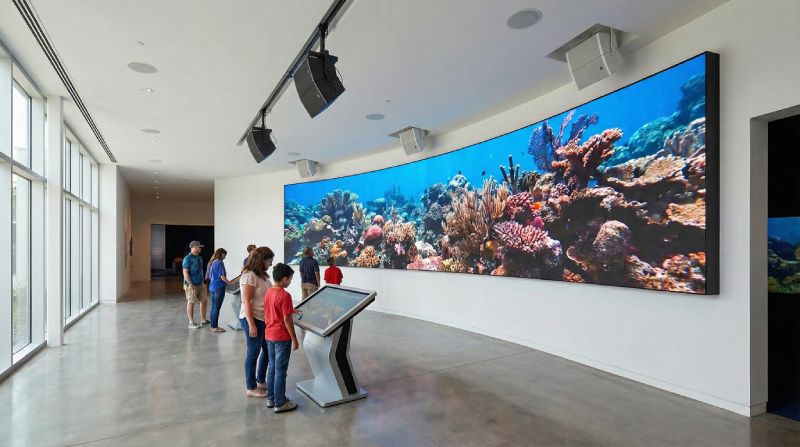
Large-format LED displays are becoming a central component of museum audiovisual installations. Compared with traditional projectors, LED walls provide superior brightness, contrast, and color accuracy—making them ideal for immersive exhibitions.
Museums use LED display technology to:
Because LED displays maintain excellent visibility even in bright environments, they are particularly useful for open exhibition halls or high-traffic visitor areas.
In some modern museums, entire rooms are surrounded by digital LED walls that allow visitors to step inside historical landscapes, natural ecosystems, or artistic worlds.
Interactivity is another key advantage of audiovisual technology in museum environments. Touchscreens and digital kiosks allow visitors to explore content at their own pace.
Interactive displays often provide:
For example, visitors examining a fossil exhibit can use a touchscreen to rotate a 3D model, learn about the species’ evolution, or watch a reconstruction of the animal in motion.
This personalized learning experience makes exhibitions far more engaging, especially for younger visitors.
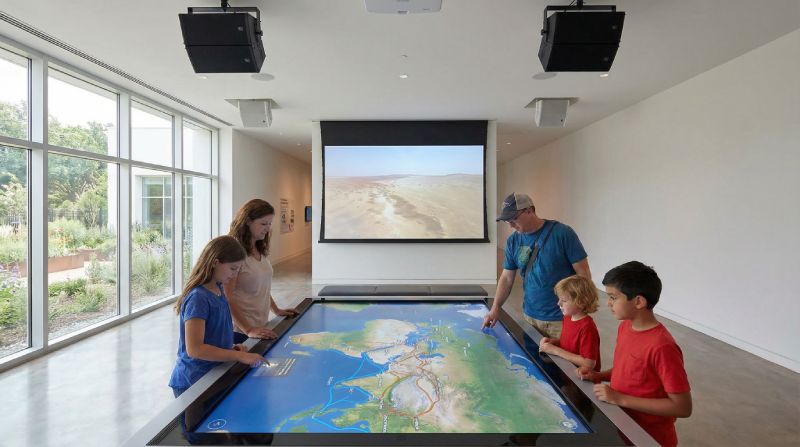
While visual elements often dominate exhibition design, sound plays an equally important role in immersive storytelling. Modern audiovisual technology includes advanced audio systems that create spatial soundscapes aligned with visual content.
Museums use immersive audio to:
Directional speakers can even deliver audio content to specific locations without disturbing nearby visitors, allowing multiple exhibits to operate simultaneously within the same gallery.
Virtual reality (VR) and augmented reality (AR) represent the next frontier of audiovisual technology in museums.
VR allows visitors to fully immerse themselves in digitally recreated environments. For instance, visitors may walk through a reconstructed ancient temple or explore the interior of a spacecraft.
AR, on the other hand, enhances real-world exhibits with digital overlays. Using a tablet or smartphone, visitors can point at an artifact and instantly view additional layers of information such as:
These technologies bridge the gap between physical artifacts and digital storytelling.
Another important benefit of audiovisual technology is its ability to make museums more accessible.
Modern audiovisual systems support features such as:
By offering multiple ways to experience the same content, museums can serve broader and more diverse visitor groups.
As display technologies, real-time rendering, and artificial intelligence continue to advance, the role of audiovisual technology in museums will become even more significant.
Future museum experiences may include:
These innovations will further blur the boundaries between education, entertainment, and digital storytelling.
Museums are no longer just places for observing artifacts—they are becoming immersive environments where history, science, and culture come alive. By integrating audiovisual technology such as projection mapping, LED display walls, interactive interfaces, immersive audio, and VR/AR experiences, museums can transform traditional exhibitions into engaging, multi-sensory journeys.
For visitors, this means deeper understanding and stronger emotional connections with the stories behind each exhibit. For museums, it means creating unforgettable experiences that inspire curiosity and learning.
As technology continues to evolve, audiovisual technology will remain a powerful tool for museums seeking to bring their exhibits—and the stories they tell—to life.

